
ACL Surgeon in Ranchi for ACL Injury, Reconstruction and Sports Injury Care
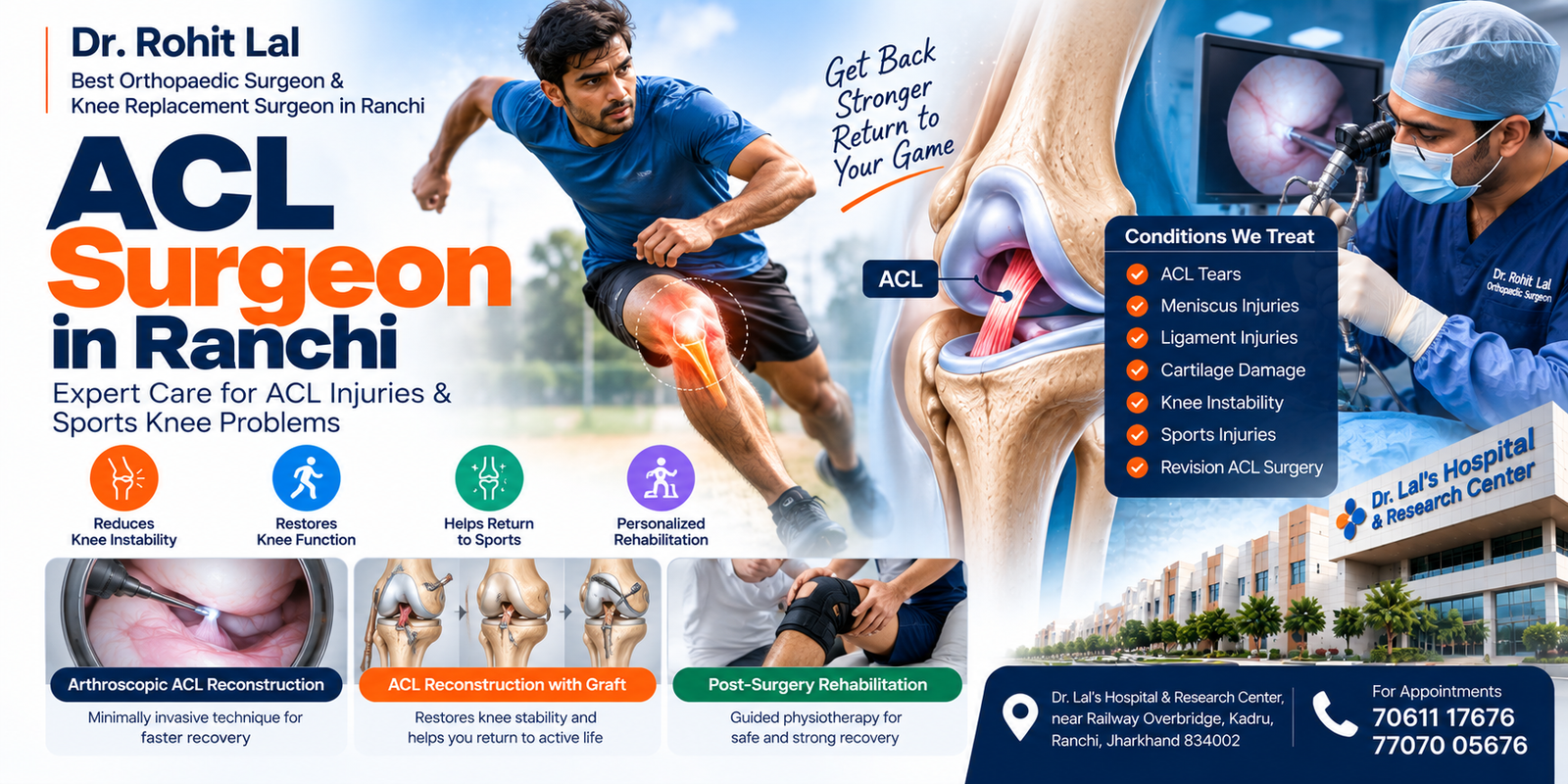
ACL Surgeon in Ranchi for ACL Injury, Reconstruction and Sports Injury Care
The anterior cruciate ligament, commonly known as the ACL, is one of the important ligaments responsible for maintaining stability in the knee. ACL injuries are particularly common among people involved in sports or activities that require sudden stopping, jumping, landing or changes in direction. However, an ACL injury can also occur because of accidents, falls or other trauma.
For someone searching for an ACL Surgeon in Ranchi, understanding the injury, available treatment options, diagnosis and rehabilitation process is an important first step.
Dr. Rohit Lal is a joint replacement and arthroscopy surgeon based in Ranchi. His website lists ACL surgery, knee arthroscopy and sports medicine among his orthopedic services. The site also states that Dr. Lal has experience in more than 4,000 joint replacement and arthroscopy procedures.
What Is an ACL Injury?
The anterior cruciate ligament connects the thighbone, or femur, with the shinbone, or tibia. It contributes to stability of the knee, particularly during movements involving changes in direction and rotation.
An ACL injury can range from a sprain to a partial or complete tear.
According to the American Academy of Orthopaedic Surgeons, common mechanisms include suddenly stopping, rapidly changing direction, landing incorrectly and direct impact to the knee. Symptoms can include a popping sensation, swelling, pain, difficulty bearing weight and a feeling that the knee is giving way.
A consultation with an ACL Surgeon in Ranchi can help determine the extent of the injury and whether surgical or non-surgical treatment may be appropriate.
Common Causes of ACL Injuries
ACL injuries can occur during many different activities.
Common situations include:
- Football
- Cricket
- Basketball
- Badminton
- Running
- Jumping
- Sudden changes in direction
- Incorrect landing
- Road accidents
- Falls
- Direct impact to the knee
Sports that involve rapid acceleration, deceleration and pivoting can place significant stress on the knee.
However, not every knee injury during sports is an ACL injury. A proper clinical assessment is necessary to identify the affected structure.
An ACL Surgeon in Ranchi can evaluate the injury and determine whether the ACL, meniscus, cartilage or other knee structures have also been affected.
ACL Injury Symptoms
The symptoms of an ACL injury can vary according to the severity of the injury.
Common symptoms may include:
A Popping Sensation
Some people report hearing or feeling a “pop” at the time of injury.
Knee Swelling
Swelling can develop relatively quickly after an acute knee injury.
Pain
Pain may make it difficult to walk or put weight on the affected leg.
Knee Instability
The knee may feel as though it is giving way, particularly during turning or pivoting movements.
Reduced Movement
Some patients may have difficulty fully bending or straightening the knee.
Difficulty Continuing Sports
An injury may prevent a person from continuing the activity that caused it.
The AAOS notes that a history and physical examination are important parts of the initial assessment, while MRI may be used to confirm an ACL injury and identify associated damage to the meniscus, cartilage or other ligaments.
Why Early Evaluation Matters
After a significant knee injury, continuing demanding activities without proper evaluation can potentially worsen symptoms or cause additional problems.
If the knee repeatedly gives way, the patient may experience further injury to structures such as the meniscus or cartilage.
This does not mean every ACL injury requires immediate surgery. Treatment depends on factors such as knee stability, activity level, associated injuries, overall health and individual goals.
An ACL Surgeon in Ranchi can evaluate these factors before recommending a treatment plan.
How Is an ACL Injury Diagnosed?
Diagnosis usually begins with a detailed medical history and physical examination.
The orthopedic specialist may ask:
- How did the injury occur?
- Did the knee twist?
- Was there a popping sensation?
- Did swelling develop?
- Can you put weight on the leg?
- Does the knee feel unstable?
- Have you had previous knee injuries?
- What activities or sports do you participate in?
The doctor may then perform specific knee stability tests.
Imaging
Depending on the clinical findings, imaging may be recommended.
An X-ray can help identify certain bone injuries, while MRI can provide detailed information about soft tissues such as:
- ACL
- Meniscus
- Cartilage
- Other ligaments
The AAOS states that MRI can help confirm ACL injury and identify associated injuries.
Does Every ACL Injury Require Surgery?
No.
This is an important point for patients searching for an ACL Surgeon in Ranchi.
Treatment depends on several factors, including:
- Severity of the injury
- Degree of knee instability
- Patient’s age
- Activity level
- Work requirements
- Sports participation
- Associated injuries
- Patient preferences
- Overall health
Some patients with lower activity requirements and relatively stable knees may be managed without reconstruction.
Treatment may involve:
- Physiotherapy
- Strengthening exercises
- Activity modification
- Bracing in selected cases
- Gradual return to activity
The AAOS notes that treatment decisions depend on knee function, activity or work demands and other individual factors.
When Is ACL Reconstruction Considered?
ACL reconstruction may be considered when the knee remains unstable or when the patient needs a higher level of knee stability for sports, work or daily activities.
Surgery may also be considered when there are associated injuries involving the meniscus, cartilage or multiple ligaments.
An ACL Surgeon in Ranchi evaluates the complete condition before determining whether reconstruction is appropriate.
The decision should not be based simply on the patient’s desire to return to sports or on an MRI report alone. Clinical examination, symptoms and functional requirements all contribute to treatment planning.
What Is ACL Reconstruction?
ACL reconstruction is a surgical procedure in which the damaged ACL is replaced with a graft.
The purpose is to restore stability to the knee and help the patient regain functional movement.
Dr. Rohit Lal’s ACL surgery page describes arthroscopic ACL reconstruction and mentions the use of autografts or allografts depending on the treatment plan.
The exact surgical technique and graft selection depend on individual patient factors and should be discussed with the treating surgeon.
Arthroscopic ACL Reconstruction
Modern ACL reconstruction is commonly performed using arthroscopic techniques.
During arthroscopy, a small camera is inserted through a small incision to visualize the inside of the knee.
Additional small incisions may be used to introduce specialized surgical instruments.
Dr. Rohit Lal’s website describes arthroscopic ACL reconstruction as part of his ACL treatment service.
Arthroscopic surgery can provide access to the knee joint through relatively small surgical openings, but it remains a significant surgical procedure requiring appropriate rehabilitation.
ACL Surgery and Meniscus Injuries
An ACL injury can occur alongside damage to other structures in the knee.
The meniscus is a cartilage structure that helps absorb shock and contributes to knee function.
When an ACL injury occurs together with a meniscus tear, both problems may need to be evaluated.
The AAOS notes that MRI can help identify associated meniscus, cartilage and ligament injuries.
The appropriate treatment depends on the specific injury pattern.
Preparing for ACL Surgery
If reconstruction is recommended, preparation can be an important part of treatment.
The orthopedic team may assess:
- Knee movement
- Swelling
- Muscle strength
- General health
- Existing medical conditions
- Previous surgeries
- Current medications
- Imaging results
In some cases, physiotherapy may be recommended before surgery to improve knee movement and reduce swelling.
The AAOS notes that many patients receive physical therapy before ACL surgery to restore knee motion and allow swelling or wounds to settle before an operation.
An ACL Surgeon in Ranchi can explain the preparation required based on the individual patient’s condition.
Recovery After ACL Surgery
ACL recovery is a process rather than a single event.
After surgery, rehabilitation generally focuses on progressively restoring:
- Knee movement
- Muscle strength
- Balance
- Stability
- Coordination
- Functional ability
The exact rehabilitation timeline varies.
The AAOS notes that postoperative care can include physical therapy, with progression based on pain control, range of motion and muscle strength.
Dr. Rohit Lal’s ACL service page also describes personalized physiotherapy and rehabilitation as part of the recovery process.
Physiotherapy After ACL Reconstruction
Physiotherapy is an important component of ACL rehabilitation.
Depending on the stage of recovery, rehabilitation may involve:
Early Stage
- Managing swelling
- Improving knee movement
- Activating muscles
- Gradual weight-bearing according to medical advice
Strengthening Stage
- Quadriceps strengthening
- Hamstring strengthening
- Hip strengthening
- Balance exercises
Functional Stage
- Coordination exercises
- Controlled movement
- Agility exercises
- Sport-specific preparation when appropriate
Return-to-Sport Stage
Athletes may require progressive sport-specific exercises before returning to competitive activities.
The rehabilitation plan should be individualized rather than based on a fixed timeline.
Returning to Sports After ACL Surgery
Returning to sports too early can increase the risk of reinjury.
The timing of return depends on:
- Knee stability
- Strength
- Range of motion
- Balance
- Functional testing
- Rehabilitation progress
- Type of sport
A player returning to football may have different requirements from someone who simply wants to walk comfortably.
An ACL Surgeon in Ranchi can work with the rehabilitation team to establish an appropriate recovery plan.
ACL Injury Prevention
Although not every ACL injury can be prevented, appropriate training may help improve movement patterns and physical conditioning.
Useful areas may include:
- Strength training
- Balance training
- Flexibility
- Landing technique
- Agility training
- Proper warm-up
- Sport-specific conditioning
Athletes should follow guidance from qualified sports and rehabilitation professionals.
ACL Surgery for Athletes
Athletes often have specific treatment goals.
Their priorities may include:
- Knee stability
- Returning to training
- Returning to competition
- Preventing further injury
- Restoring strength
- Improving confidence in the knee
An athlete’s treatment plan should therefore consider both the injury and the physical demands of their sport.
The decision regarding surgery should be individualized.
How to Choose an ACL Surgeon in Ranchi
Patients searching for an ACL Surgeon in Ranchi should consider several factors rather than relying only on online rankings.
Orthopedic Qualifications
Review the surgeon’s orthopedic education and training.
ACL and Arthroscopy Experience
Look for relevant experience in ACL reconstruction and arthroscopic knee surgery.
Sports Injury Expertise
Patients involved in sports may benefit from discussing sports-specific rehabilitation requirements.
Diagnostic Approach
A proper diagnosis should precede treatment.
Rehabilitation Program
Ask how postoperative physiotherapy and follow-up are managed.
Hospital Facilities
Consider the surgical, diagnostic and postoperative infrastructure available.
Clear Communication
The surgeon should explain treatment alternatives, expected recovery, possible risks and rehabilitation requirements.
ACL Treatment at Dr. Rohit Lal Ortho Hospital
Dr. Rohit Lal’s website lists ACL Surgery, Knee Arthroscopy and Sports Medicine among its orthopedic services.
The ACL service page describes arthroscopic ACL reconstruction and postoperative rehabilitation.
The hospital is located near Kadru Over Bridge, Kadru Road, Ranchi, Jharkhand 834002. The website lists contact numbers 70611 17676 and 77070 05676.
Patients can discuss their injury, imaging reports, activity requirements and treatment options during consultation.
When Should You See an ACL Specialist?
Consider an orthopedic consultation after a knee injury if you experience:
- A popping sensation
- Significant swelling
- Persistent knee pain
- Difficulty bearing weight
- Repeated knee instability
- Knee giving way
- Reduced range of motion
- Difficulty returning to sports
- Persistent symptoms after an injury
These symptoms do not confirm an ACL tear by themselves. A medical assessment is required for diagnosis.
Frequently Asked Questions
Can an ACL tear heal without surgery?
Some ACL injuries can be managed non-surgically depending on knee stability, activity level and individual circumstances. An orthopedic evaluation is needed to determine the appropriate approach.
Is ACL reconstruction performed using arthroscopy?
Arthroscopic techniques are commonly used for ACL reconstruction. Dr. Rohit Lal’s website specifically describes arthroscopic ACL reconstruction as part of his ACL service.
How long does ACL recovery take?
Recovery varies depending on the procedure, associated injuries, rehabilitation progress and individual factors. Return to sport should be based on functional recovery rather than a fixed date.
Can I return to sports after ACL surgery?
Many patients aim to return to sports after reconstruction, but the timing should be determined by the treating surgeon and rehabilitation team based on strength, stability and functional recovery.
Is physiotherapy necessary after ACL surgery?
Rehabilitation is an important component of ACL recovery. Physical therapy commonly focuses on restoring movement, strength, balance and functional ability.
Conclusion
An ACL injury can affect knee stability, mobility and participation in sports or other physical activities. While some injuries can be managed without surgery, others may require ACL reconstruction depending on the severity of instability, activity requirements and associated knee damage.
If you are looking for an ACL Surgeon in Ranchi, the appropriate starting point is a detailed orthopedic evaluation. Diagnosis may involve physical examination and imaging such as MRI when clinically indicated.
Dr. Rohit Lal’s orthopedic practice in Ranchi provides ACL surgery, knee arthroscopy and sports medicine services, with rehabilitation forming an important part of the treatment pathway.
Dr. Lal’s Hospital & Research Center
Near Railway Overbridge, Kadru, Ranchi, Jharkhand 834002
Phone: 70611 17676 / 77070 05676
Leave A Comment